Why Did the Senate Block a Bill to Lower Your Electric Bill?
TL;DR
|
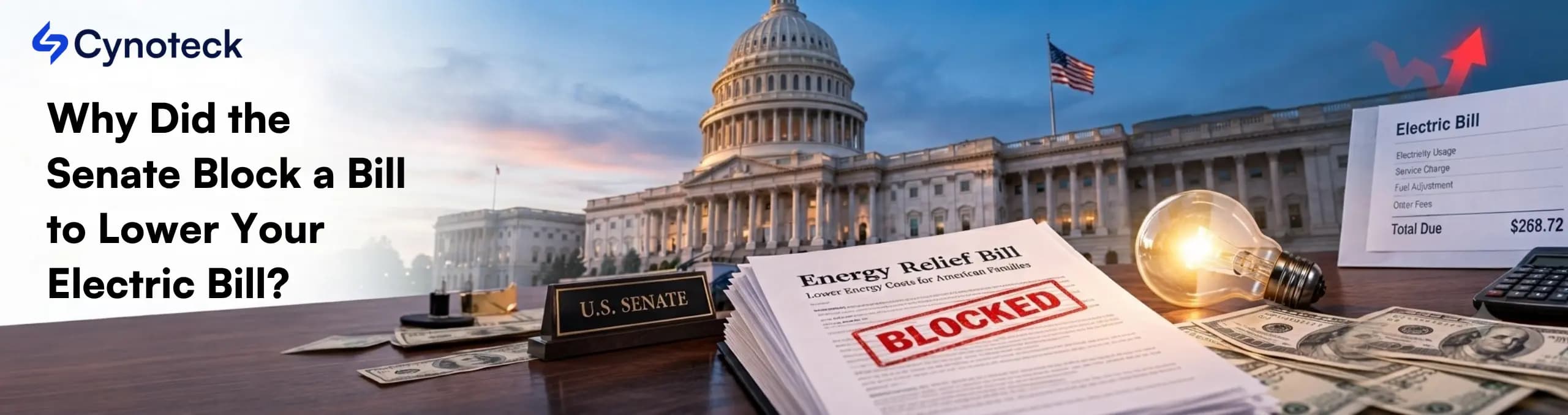
The House passed a bill on September 16 to stop AI data centers from raising your electric bill. It passed 417-3, a rare bipartisan landslide. But a day later, Senator Martin Heinrich blocked it in the Senate. He said the bill did not go far enough. So Heinrich pushed his own bill instead.
However, Senator Bernie Moreno blocked that one too. As a result, both bills are stuck, and nobody has decided who pays for the power AI needs.
Republican Senator Jon Husted tried to fast-track his bill on Thursday, using a quick method called unanimous consent. But Heinrich objected right on the Senate floor. He argued the bill only tells states to "consider" the rule, not follow it.
Data centers use huge amounts of power, so nearby communities feel the cost first. That is why lawmakers pushed both bills right before the midterm elections. However, the Senate leaves for recess soon, so neither bill has much time left to pass.
Your electric bill could climb if data centers keep expanding near you, and Congress still has not settled who pays
Neither bill has passed, so today's rules stay exactly the same for now
If your business sits near a data center, expect this fight to resurface right after the midterms
Data centers could use over 15% of all US electricity by 2030, so this fight touches nearly every state, not just tech hubs
We helped organizations choose the right AI platform, integrate, and scale AI solutions that drive real business impact and track measurable results.
Book a Free ConsultationThe two proposals are not just political rivals. They take genuinely different approaches:
Ratepayer Protection Act | GRID Savings Act | |
|---|---|---|
Sponsor | Sen. Jon Husted (R-OH) | Sen. Martin Heinrich (D-NM) |
Threshold | Data centers ≥100 MW | Data centers ≥150 MW |
Requirement | States "consider" adopting the standard within 2 years | Data centers must pay 100% of connection costs, no opt-out |
Extra provisions | None specified | Community engagement, water-use limits, clean energy requirements |
House status | Passed 417-3 | Not yet voted on |
To be fair to both senators: Husted's bill carries real bipartisan momentum; a 417-3 vote is rare in any Congress. Heinrich's core complaint also holds up: "consider" a rule is not the same as requiring it, and that gap is structural, not just political spin.
This fight exists because data centers already strain the grid in some regions. That strain is the same underlying pressure pushing up Treasury yields and mortgage rates this month. Electricity bills are simply that cost, showing up monthly instead of on a loan statement.
For businesses operating near a data center, plan for cost uncertainty now. Congress may not resolve this before your next lease renewal.
Our machine learning development team can help you model AI infrastructure costs under several possible regulatory outcomes, not just today's pricing.
A: No. The House passed the Ratepayer Protection Act, but the Senate blocked a fast-track vote on it and blocked the competing GRID Savings Act too. Neither has become law.
A: Possibly. In some regions, it already has, according to lawmakers on both sides. This fight is about who covers those costs, not whether they exist.
A: Both bills sit in committee. The Senate recesses soon, and midterms follow in November, so neither bill is likely to move quickly.
.png)
Cynoteck wins the ET Leadership Excellence Award 2025 for excellence in IT consulting, recognizing its business-focused, scalable, and high-impact technology solutions.
We are more than just developers and consultants—we are your partners in navigating the digital landscape. Let us be the engine behind your next big success while you focus on your core vision.
Explore Opportunities! Cynoteck Recognized as a Clutch Global Leader for Spring 2024.png)


 Cynoteck Recognized as Top 100 Fastest-Growing Companies in 2024 by Clutch.png)