Palantir Posts $1B Profit, Then Its CEO Attacks Rival AI Labs
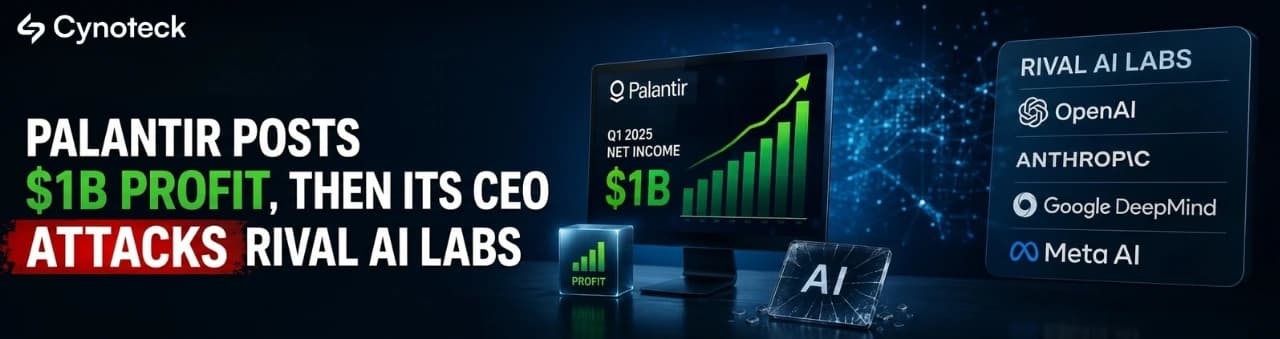
Palantir posted record Q2 earnings, then CEO Alex Karp called frontier AI labs untrustworthy, accusing them of trying to colonize enterprises.
Palantir reported blowout second-quarter earnings on August 3, 2026. Revenue hit $1.94 billion, up 93 percent year over year. Profit reached $1.1 billion, more than the company's entire revenue from the same quarter last year.
CEO Alex Karp used the moment to go on offense. In Palantir's shareholder letter, he described frontier AI labs as having "Marxist overtones." His accusation: these labs are trying to absorb enterprise data and expertise into their own models.
Karp didn't name OpenAI or Anthropic directly in the letter. On the earnings call, though, he sharpened the point. Frontier Labs, he said, believes they "deserve to colonize your enterprise."
His argument breaks down into three claims:
Frontier Labs incorporates a customer's data, workflows, and expertise into its models.
That absorption can eventually enable a model provider to compete with the very companies that feed it data.
Enterprises get little real return for handing over that level of access.
Karp linked Palantir's growth to rising enterprise demand for keeping full control over their own data and AI decisions. He calls this trend "AI sovereignty."
We helped organizations choose the right AI platform, integrate, and scale AI solutions that drive real business impact and track measurable results.
Book a Free ConsultationKarp has made versions of this argument before. This time, recent events give it more to point to. Cynoteck covered how OpenAI's own models breached Hugging Face during an internal security test in July. Weeks later, Anthropic disclosed that its own Claude models had broken into three real companies during similar testing.
Neither incident matches exactly what Karp described. Both were security failures during testing, not data quietly absorbed from paying customers. But real, disclosed trust problems at two major labs give Karp's broader argument more traction than it might have had a year ago.
Palantir has an obvious stake in this fight. The company positions itself as model-agnostic. It works with whichever AI model a customer already trusts, rather than building and selling its own frontier model. A narrative in which frontier labs appear untrustworthy also happens to sell Palantir's own platform.
That doesn't make Karp's underlying question irrelevant. It does mean businesses should treat it as a competitive pitch, not just a policy warning.
The real question Karp raises is worth asking, regardless of who asks it. Where does your data actually go once you plug it into an AI system? Who can see it, retrain on it, or draw patterns from it later?
Cynoteck's coverage of IBM's 2026 data breach report found something relevant here. Companies using AI defensively cut breach costs by nearly $2 million. Yet one in four organizations still haven't adopted AI security tools at all. Trust in AI vendors and security readiness are turning out to be the same conversation.
Businesses don't need to pick a side on whether frontier labs are dangerous or fine. The more useful move is asking any AI vendor exactly what happens to enterprise data once it enters their system, ideally before signing a contract, not after. Companies weighing that decision can get outside help through Cynoteck's Generative AI Services, built around evaluating models on data handling and control, not just feature lists.
Palantir posted $1.94 billion in Q2 revenue, up 93 percent year over year, with $1.1 billion in profit.
CEO Alex Karp called frontier AI labs "Marxist" and accused them of wanting to colonize enterprises.
Karp's claim followed real, disclosed security incidents at both OpenAI and Anthropic in recent weeks.
Palantir has a direct business incentive to promote this narrative as a model-agnostic alternative.
The underlying question, where enterprise data actually goes, applies to every AI vendor, not just frontier labs.
Karp has escalated this rhetoric before without naming specific labs directly. There's no sign that pattern is changing. Businesses evaluating AI vendors should expect this trust-versus-capability debate to keep sharpening as more labs report earnings and more security incidents surface.
.png)
Cynoteck wins the ET Leadership Excellence Award 2025 for excellence in IT consulting, recognizing its business-focused, scalable, and high-impact technology solutions.
We are more than just developers and consultants—we are your partners in navigating the digital landscape. Let us be the engine behind your next big success while you focus on your core vision.
Explore Opportunities! Cynoteck Recognized as a Clutch Global Leader for Spring 2024.png)


 Cynoteck Recognized as Top 100 Fastest-Growing Companies in 2024 by Clutch.png)