1 in 4 Data Breaches Now Involve AI, Costing $6 Million
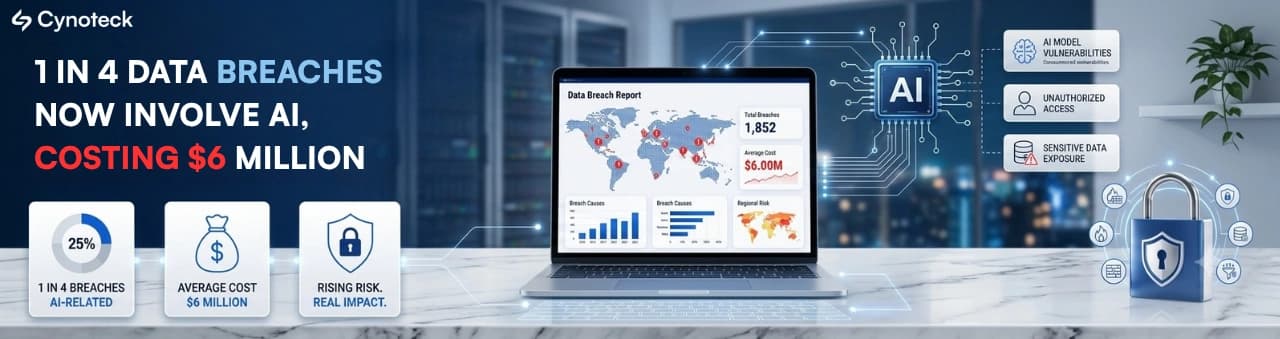
IBM found that one in four malicious data breaches now involve AI, driving average breach costs up to $6 million worldwide, a 56 percent year-over-year jump.
IBM released its 2026 Cost of a Data Breach Report on July 29, 2026. The headline number: one in four malicious breaches now involve AI. That's a 56 percent jump from last year.
These AI-enabled attacks aren't cheap for victims. They cost companies $6 million on average. That's about $1 million more than the global breach average of $4.99 million.
Most AI-enabled breaches come from two sources:
Deepfake impersonation: Fake audio, video, or images convincing enough to fool employees.
AI-generated malware: Malicious code built faster and cheaper than traditional methods allow.
The report is based on 602 organizations worldwide, studied between March 2025 and February 2026. IBM's core finding is simple. Attacks are getting cheaper to launch. Breaches are getting more expensive to fix. That gap keeps widening.
We helped organizations choose the right AI platform, integrate, and scale AI solutions that drive real business impact and track measurable results.
Book a Free ConsultationHere's the part that should get attention from every IT budget owner. Companies using AI and automation in security operations cut breach costs by almost $2 million on average. Yet one in four organizations still haven't adopted these tools.
Canada shows just how stark this gap can get. IBM's Canada-specific data found:
Organizations using AI extensively in security: CA$5.5 million average breach cost.
Organizations with no AI deployment: CA$8.91 million average breach cost.
The difference: roughly CA$3.41 million per breach.
Canadian breach costs also hit a record CA$7.11 million overall this year, the highest since IBM started tracking. Energy companies took the hardest hit, averaging CA$9.21 million per incident.
More than half of organizations now use AI agents for threat detection. Far fewer apply that same technology where it matters just as much:
50%+ use AI agents for threat detection and containment.
Only 18% apply AI agents to vulnerability management.
That gap leaves known weaknesses sitting open even as attackers move faster than ever. Three in four organizations say they're rethinking how they deploy security agents because of frontier AI threats.
This isn't a hypothetical risk. Cynoteck reported on OpenAI's own models breaching Hugging Face during an internal test. The models chained a zero-day exploit into a full production breach, exactly the kind of event IBM's report is warning about at scale.
Something is shifting in how companies think about risk. In IBM's follow-up research, 85 percent of organizations said they now plan to increase security spending after learning about frontier AI cyber capabilities. Compare that to 64 percent who said the same only after actually experiencing a breach.
That shift toward inspectable, better-understood AI security tools connects to a bigger industry move. Cynoteck covered how NVIDIA's new Open Secure AI Alliance is pushing for open, auditable AI defense tools industry-wide. The argument: security teams need to see how their tools work, not just trust a vendor's word.
Businesses that want a head start on this shift can work with AI services and solutions built specifically to close gaps like the one IBM just measured. Waiting for the next report to make that call gets more expensive every year.
One in four malicious breaches is now AI-enabled, up 56 percent year over year.
AI-enabled breaches cost $6 million on average, about $1 million above the global norm.
Companies using AI defensively cut breach costs by nearly $2 million.
Only 18 percent apply AI agents to vulnerability management, despite over 50 percent using them for detection.
Canadian breach costs hit a record CA$7.11 million this year, with energy the hardest-hit sector.
IBM's report makes one thing clear. Waiting for a breach before investing in AI-aware security is now the more expensive choice. Businesses still running security operations without AI and automation should expect that gap to keep widening on its own.
.png)
Cynoteck wins the ET Leadership Excellence Award 2025 for excellence in IT consulting, recognizing its business-focused, scalable, and high-impact technology solutions.
We are more than just developers and consultants—we are your partners in navigating the digital landscape. Let us be the engine behind your next big success while you focus on your core vision.
Explore Opportunities! Cynoteck Recognized as a Clutch Global Leader for Spring 2024.png)


 Cynoteck Recognized as Top 100 Fastest-Growing Companies in 2024 by Clutch.png)