OpenAI's Open-Source Agent Engine Slashes Token Costs 6x
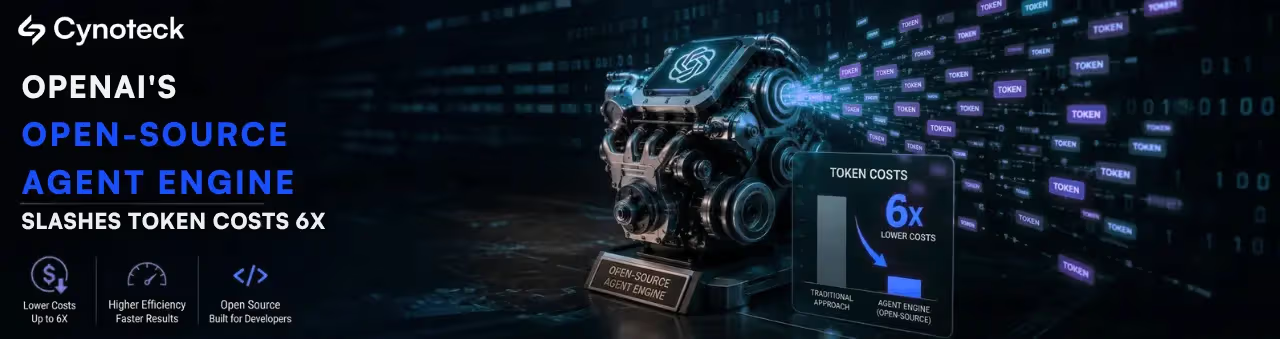
OpenAI open-sourced Harness, the engine behind Codex, cutting AI agent token costs sixfold while boosting benchmark scores today.
OpenAI open-sourced Harness on August 20, 2026. It's the core engine that powers Codex, OpenAI's coding agent, now released under the Apache-2.0 license. Developers can modify, embed, and sell products built on it without restriction.
The release isn't just a code dump. OpenAI is pitching Harness as infrastructure any company can build its own AI agents on, not just a tool for writing code.
Building an AI agent that works reliably involves far more than picking a good model. Harness manages the parts most teams struggle to build well:
Task comprehension and breaking a request into steps.
Long-conversation memory that persists across a multi-turn task.
Real-time event streaming, so a user can watch progress as it happens.
Tool invocation, letting the agent call outside functions or APIs.
Interruptibility, so a user can stop or redirect the agent mid-task.
Human-in-the-loop approval, requiring sign-off before sensitive actions.
The release ships in three layers. codex exechandles one-off scripted tasks from the command line. A full SDK lets developers embed Codex into an application. An app-serverprotocol serves products that need the agent as an ongoing, first-class part of the experience.
We helped organizations choose the right AI platform, integrate, and scale AI solutions that drive real business impact and track measurable results.
Book a Free ConsultationOpenAI backed the announcement with concrete performance data, not just architecture diagrams:
Optimizing Harness alone raised GPT-5.6 Sol's score on the ARC-AGI-3 benchmark from 13.3 percent to 38.3 percent.
Token consumption dropped to one-sixth of its previous volume for comparable tasks, directly cutting API costs.
A tax-preparation pilot using Harness processed 7,000 returns and cut preparation time by roughly a third.
Cisco is already using the Codex SDK inside its Cloud Control platform to build custom tools. Thrive Holdings and Crete built their tax-prep workflow on the same foundation. They incorporated direct feedback from tax practitioners into the agent's process.
The framing here matters. OpenAI isn't pitching Harness as a coding assistant alone. It's pitching it as something to embed inside a product a company already has. That's a meaningfully different sales pitch. It puts Harness in direct competition with Anthropic's own Claude Agent SDK.
This connects directly to ChatGPT Work, the autonomous business agent product covered earlier. Harness is the same underlying engine class powering that product. It's now available for any company to build on independently, not only through OpenAI's own apps.
It also arrives one day after OpenAI announced Private Safety Processing, a system for catching AI misuse without storing customer data, and the same week OpenAI launched a ChatGPT plugin that reads and sends iMessages on Mac. Together, these announcements sketch a clear roadmap. OpenAI wants to be the layer other companies build their own agent products on, shipping platform reach, governance, and integrations all in the same stretch of days.
Companies building custom AI agents face a real decision now. Build the orchestration layer from scratch. Adopt a vendor's closed platform. Or build on an open-source engine like Harness that a major lab has already spent years hardening in production.
A similar infrastructure decision is playing out elsewhere too, including how Databricks and Microsoft are deepening their own AI platform partnership around the same build-versus-adopt question. Teams weighing whether to build agents on Harness, a closed alternative, or a fully custom stack can get a clearer starting point through agentic AI development services built around exactly that kind of architecture decision.
OpenAI open-sourced Harness, the engine behind Codex, under the Apache-2.0 license on August 20, 2026.
Optimizing the engine alone raised a benchmark score from 13.3 percent to 38.3 percent while cutting token use sixfold.
Cisco, Thrive Holdings, and Crete are already using it in production tools.
The release positions Harness as a platform for building custom AI agents, not just a coding tool.
It lands one day after OpenAI's Private Safety Processing announcement, part of the same broader platform push.
OpenAI is likely to keep expanding what ships through this open harness rather than locking capability behind its own apps. Businesses evaluating AI agent infrastructure should treat this release as a serious open-source option worth testing, not just a developer curiosity.
.png)
Cynoteck wins the ET Leadership Excellence Award 2025 for excellence in IT consulting, recognizing its business-focused, scalable, and high-impact technology solutions.
We are more than just developers and consultants—we are your partners in navigating the digital landscape. Let us be the engine behind your next big success while you focus on your core vision.
Explore Opportunities! Cynoteck Recognized as a Clutch Global Leader for Spring 2024.png)


 Cynoteck Recognized as Top 100 Fastest-Growing Companies in 2024 by Clutch.png)