ChatGPT Can Now Read and Send Your iMessages on Mac
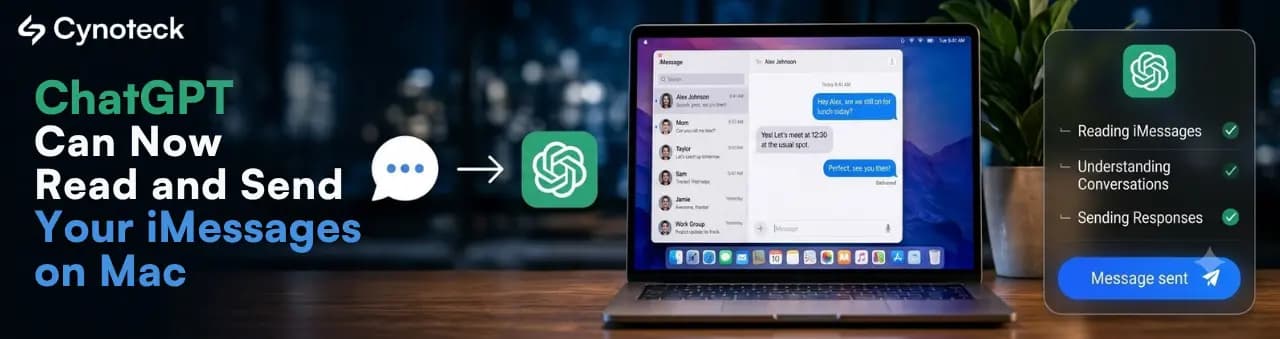
OpenAI launched a ChatGPT plugin that reads, drafts, and sends iMessages on Mac today, raising fresh privacy questions for Apple.
OpenAI rolled out a new ChatGPT plugin on Thursday, August 20, 2026. It connects directly to Apple's Messages app on Mac. The plugin can read, search, draft, and send texts across iMessage, SMS, and RCS. Users no longer need to copy and paste conversations into a chat window.
The plugin works across every ChatGPT plan. It's also built into Codex and ChatGPT Work, meaning businesses can use it for professional messaging, not just personal texts.
Once connected, ChatGPT can handle several tasks directly inside a user's real conversations:
Search message history for specific information or past conversations.
Summarize recent chats or catch a user up on what they missed.
Draft replies based on the conversation's context.
Send messages on a user's behalf, or delete existing ones.
Setup isn't a single toggle. Users must grant Full Disk Access in Mac system settings, along with contacts and automation permissions. A permissions screen inside ChatGPT also confirms that it will access on-device message history before anything connects.
By default, ChatGPT asks for approval before sending a message. OpenAI specifically discourages turning that step off. Doing so, the company warns, removes the user's last chance to review a message before it goes out under their name.
We helped organizations choose the right AI platform, integrate, and scale AI solutions that drive real business impact and track measurable results.
Book a Free ConsultationApple has spent years positioning message privacy as a core part of its brand. Handing an outside AI company direct access to iMessage content, even locally, sits uneasily next to that reputation.
OpenAI told Bloomberg the plugin runs entirely on the user's own Mac. It relies on existing macOS tools like AppleScript and Accessibility, rather than uploading raw message data to OpenAI's servers. The company also said it "doesn't create an index of all someone's messages." What that distinction means in technical practice hasn't been detailed publicly yet.
Timing adds another layer here. This plugin arrives while Apple is suing OpenAI over an unrelated hardware dispute, and while Apple is preparing its own upgraded Siri AI. Neither company seems eager to hand the other favorable headlines right now. Apple has not commented on the new plugin.
This launch lands just one day after OpenAI announced Private Safety Processing, a system built to catch AI misuse without storing customer data. That announcement was itself a response to trust concerns following the Hugging Face breach OpenAI disclosed in July.
The Messages plugin tests the same trust question from a different angle. Promising that data isn't retained on a server is one thing. Convincing users that granting Full Disk Access to a chatbot is safe by design, not just by policy, is another.
The plugin's business use case adds real weight here too. ChatGPT Work launched earlier as an autonomous agent for business projects. Wiring that same agent into a company's actual message threads is a meaningfully bigger ask than summarizing a spreadsheet, even with an admin toggle to disable it available through Computer Use.
Any business considering this plugin for professional use should treat the permission list as seriously as the feature list. Full Disk Access and automation permissions are broad grants, not narrow ones. Workspace administrators can disable the plugin entirely. Businesses with sensitive client communications should decide deliberately whether to allow it at all, rather than leave it available by default. Evaluating conversational AI tools against that standard, not just their feature list, is exactly what Generative AI Services are built to help with.
OpenAI launched a ChatGPT plugin for Mac on August 20, 2026, connecting directly to Apple's Messages app.
The plugin can read, search, draft, send, and delete messages across iMessage, SMS, and RCS.
It integrates with Codex and ChatGPT Work, extending its use into business messaging.
OpenAI says the plugin runs locally and doesn't index all messages, though full technical detail isn't public yet.
The launch comes during an active lawsuit between Apple and OpenAI, and as Apple builds its own AI features.
Apple has not responded publicly to the plugin's launch. Businesses evaluating it for professional use should wait for OpenAI's promised technical details on how local processing actually works before granting it access to sensitive communications.
.png)
Cynoteck wins the ET Leadership Excellence Award 2025 for excellence in IT consulting, recognizing its business-focused, scalable, and high-impact technology solutions.
We are more than just developers and consultants—we are your partners in navigating the digital landscape. Let us be the engine behind your next big success while you focus on your core vision.
Explore Opportunities! Cynoteck Recognized as a Clutch Global Leader for Spring 2024.png)


 Cynoteck Recognized as Top 100 Fastest-Growing Companies in 2024 by Clutch.png)