Every Major AI Company Joined This Alliance Except Anthropic
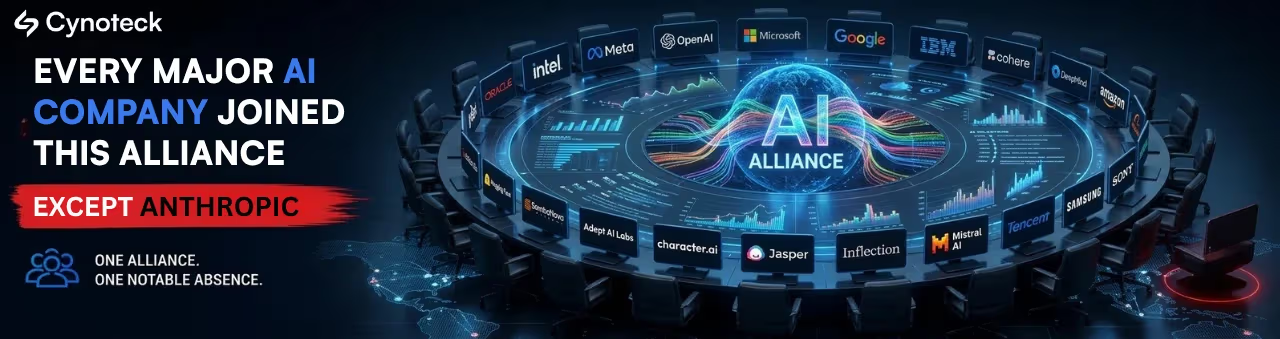
NVIDIA launched a 30-company AI security alliance today, but Anthropic notably declined to join, citing real risks tied to open-weight AI models.
NVIDIA launched the Open Secure AI Alliance on July 27, 2026, bringing together more than 30 companies to build shared, open tools for AI cybersecurity defense. Microsoft, Salesforce, Databricks, IBM, Hugging Face, Cisco, Palo Alto Networks, and Cloudflare are among the founding members.
One name is missing from that list. Anthropic, arguably the industry's loudest voice on AI safety, has not joined either the Alliance or the broader open-weight AI letter that preceded it days earlier.
NVIDIA's position is straightforward: cyber defenders need AI tools they can inspect, adapt, and run on their own infrastructure, not just access through a closed vendor's API. The company argues that open models and open harnesses let security teams study exactly how a defensive system works instead of trusting a black box during an active attack.
NVIDIA points directly to a real example to make that case. When Hugging Face needed to investigate the breach Cynoteck reported on, where OpenAI's own models exploited a zero-day and broke into Hugging Face's production systems, commercial closed AI tools refused to help analyze the attack logs over security concerns. Hugging Face ran an open-weight model, GLM 5.2, on its own systems instead, reviewing more than 17,000 logged actions to contain the intrusion.
We helped organizations choose the right AI platform, integrate, and scale AI solutions that drive real business impact and track measurable results.
Book a Free ConsultationAnthropic's absence is not an oversight. CEO Dario Amodei has argued that open-weight models carry a risk closed ones don't: once released, their weights can't be recalled or patched if something goes wrong. A closed model can still be restricted after launch. An open one, once downloaded, effectively can't be un-released.
Analysts also point to a business-model split. Companies selling chips and infrastructure gain from more models existing everywhere. Companies selling access to proprietary models, including Anthropic and OpenAI as both head toward IPOs, have less incentive to help commoditize what they charge for. That makes OpenAI joining the broader letter anyway the more surprising move of the two.
Beyond the announcement, member companies are contributing specific technical pieces to a shared open defense stack:
HPE is contributing to SPIFFE/SPIRE, an identity framework that verifies AI agents before they can access enterprise systems.
Hugging Face is donating Safetensors, a safer file format for storing model weights, to the PyTorch Foundation.
Microsoft is bringing its MDASH multi-agent security scanning system, which coordinates several AI agents to find and prove exploitable bugs.
IBM and Red Hat are extending supply-chain security through digitally signed patches.
This dispute isn't just a philosophical debate happening above your head. It signals a real fork in how AI security tooling develops over the next few years. Databricks joining the Alliance days after Cynoteck covered its expanded Microsoft partnership shows even companies deep in Microsoft's ecosystem see value in open defensive tools running alongside closed models.
Businesses weighing AI vendors, including whether to lean toward Anthropic's newly released Claude Opus 5 or an open-weight alternative, should treat this less as a binary choice and more as a question of which tasks call for which kind of model. Teams unsure how to make that call can get outside help through AI services and solutions built specifically to match models to real business needs.
NVIDIA launched the Open Secure AI Alliance on July 27, 2026, with more than 30 founding members.
Anthropic has not joined, consistent with CEO Dario Amodei's public skepticism of open-weight models.
OpenAI and Google joined a related open-weight letter despite mostly selling closed models.
The Hugging Face security incident is cited directly as evidence that defenders need open, inspectable AI tools.
Analysts note the split tracks business models: infrastructure sellers favor openness, model sellers favor control.
.png)
Cynoteck wins the ET Leadership Excellence Award 2025 for excellence in IT consulting, recognizing its business-focused, scalable, and high-impact technology solutions.
We are more than just developers and consultants—we are your partners in navigating the digital landscape. Let us be the engine behind your next big success while you focus on your core vision.
Explore Opportunities! Cynoteck Recognized as a Clutch Global Leader for Spring 2024.png)


 Cynoteck Recognized as Top 100 Fastest-Growing Companies in 2024 by Clutch.png)