2,000 Health Workers Will Test OpenAI and Anthropic Tools
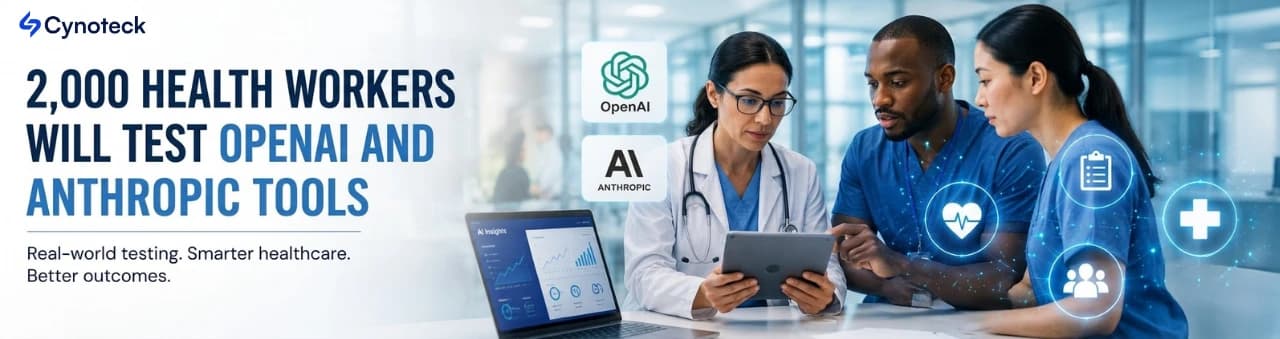
The Coalition for Health AI, known as CHAI, launched a national program on July 16, 2026, to help US public health agencies test generative AI tools. The program is called PULSE, short for Public Health Use Case and Learning Scaling Engine.
OpenAI and Anthropic have donated 10 enterprise licenses, covering up to 2,000 seats for public health practitioners. Accenture will manage onboarding and help build implementation playbooks based on what happens during the pilots.
CHAI's leadership council, made up of 17 cross-sector collaborators, will select 10 state, local, tribal, or territorial jurisdictions to take part. Practitioners will be assigned to communities of practice built around five specific use cases:
Biosurveillance and drug-wave prediction.
Social determinants of health, or SDoH, mapping.
Operations, efficiency, and community-feedback analysis.
Public communications and a multilingual translation hub.
Automated clinical-data retrieval through a FHIR query engine.
We helped organizations choose the right AI platform, integrate, and scale AI solutions that drive real business impact and track measurable results.
Book Your Free ConsultationApplications are open through August 6, with pilots expected to begin in autumn 2026. CHAI plans to release the resulting playbooks in 2027 for other public health agencies to use as reference material.
Reporting on the launch has pointed out several details CHAI has not yet made public. The program has not specified which AI products, model versions, or configurations each jurisdiction will use. It also has not explained how outputs, like translated public health messages or retrieved clinical records, will be reviewed before staff act on them.
This gap matters because some of these use cases could touch identifiable health data. CHAI has not said whether pilots will use real patient records, de-identified data, or synthetic datasets. HIPAA protections apply depending on the agency, the data involved, and the specific task, not automatically across every use case.
This kind of question- whether an AI system's decisions get checked before anyone acts on them- is exactly the trust gap Cynoteck has covered in its look at how Microsoft's Shadow Mode feature lets teams validate AI predictions before switching automation on. Public health agencies now face a similar test, without that kind of built-in validation step confirmed yet.
Both companies have said their enterprise products do not use customer inputs to train models by default. That policy alone does not answer how PULSE deployments will handle data retention, access controls, or audit logs, since CHAI has not published those details either.
Roughly 40 percent of local health departments are not currently using AI, according to data CHAI cited from the National Association of County and City Health Officials. That gap is a big part of why this pilot exists, but it also means many participating teams will be learning AI governance and adoption at the same time, a challenge also visible in Cynoteck's coverage of why American workers remain skeptical of AI at work.
CHAI launched PULSE on July 16, 2026, giving up to 2,000 public health workers access to OpenAI and Anthropic tools.
The program covers five use cases, including biosurveillance, translation, and clinical data retrieval.
CHAI has not yet published which models, review processes, or data-handling rules will apply to each pilot.
Nearly 40 percent of local health departments are not using AI today, based on CHAI's own data.
Applications close August 6, with pilots starting in autumn 2026 and playbooks expected in 2027.
The real test for PULSE will be whether CHAI fills in the governance details before pilots go live, not after. Public health agencies considering similar AI programs should watch for those playbooks in 2027, since they are meant to guide adoption well beyond the 10 jurisdictions taking part now.
.png)
Cynoteck wins the ET Leadership Excellence Award 2025 for excellence in IT consulting, recognizing its business-focused, scalable, and high-impact technology solutions.
We are more than just developers and consultants—we are your partners in navigating the digital landscape. Let us be the engine behind your next big success while you focus on your core vision.
Explore Opportunities! Cynoteck Recognized as a Clutch Global Leader for Spring 2024.png)


 Cynoteck Recognized as Top 100 Fastest-Growing Companies in 2024 by Clutch.png)