Is Claude Speeding Up Drug Development? What the Early Results Show
TL;DR
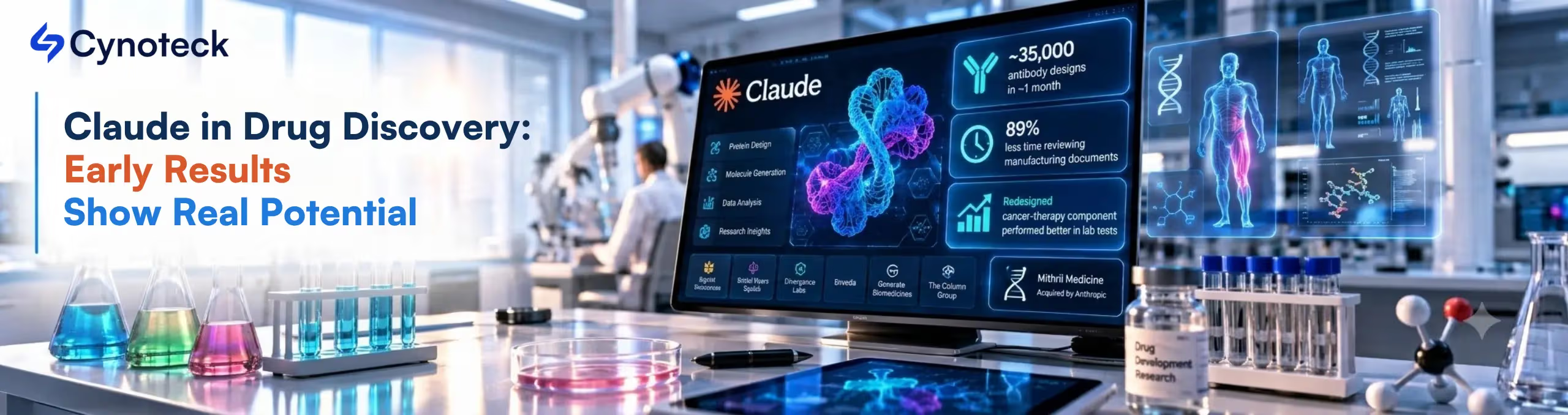
Anthropic reported early results from partnerships with BigHat Biosciences, Bristol Myers Squibb, Divergence Labs, Enveda, Generate Biomedicines, and The Column Group. It also acquired Mithril Medicine, which is developing treatments for two rare forms of muscular dystrophy. Reported results include around 35,000 antibody designs generated in roughly a month, 89% less time spent reviewing manufacturing documents, and a redesigned cancer-therapy component that performed better in lab tests. Anthropic says the work remains at an early stage and mostly preclinical. A muscular dystrophy drug could enter human trials as soon as late 2028, provided the candidates continue to show promising results.
- All reported figures are self-reported by Anthropic or its partners, with no independent verification identified in the coverage reviewed.
- No drug from this work is approved or available, and these developments should not be interpreted as evidence of an approved treatment.
Anthropic says its AI is now working inside real drug programs. In a research post on October 27, the company reported early results from partnerships with six organizations and said it has started drug discovery efforts of its own, including by acquiring a one-person biotech called Mithril Medicine. It is a detailed report. It is also written by the company that builds Claude, and nearly all of the work is preclinical, meaning it has not yet been tested in people.
What Did Each Partner Report?
Anthropic describes results at different stages of drug development:
Generate Biomedicines (cancer therapy design): six scientists used Claude Code to propose new designs for part of a CAR T-cell therapy. One design was about 70% shorter than the standard version and, in lab tests, let immune cells make roughly 10 times as many receptors, kill tumor cells more efficiently and stay active longer (Generate's technical report)
Divergence Labs (food allergy): Claude produced a design plan and, largely on its own, about 35,000 antibody designs in a month. Early tests found 3 designs that bound IgE and 20 that dislodged it, with 3 of those 20 doing so better than a standard medicine (Divergence's technical report)
BigHat Biosciences (improving drug candidates): Claude proposed changes to two antibody fragments, and the lab tested about 1,010 variants in 10 weeks. The best versions bound more than 10 times more tightly, and one clumped more than 100 times more slowly (BigHat's technical report)
Enveda (manufacturing and filings): on 1,061 pages of records, Claude caught all 11 issues human reviewers found plus 7 they had missed, cutting review time by 89%. A first draft of one regulatory document took four hours, versus about three months by hand (Enveda's technical report)
The Column Group: is creating a company called Pleiades, whose first Claude skill for judging drug targets has been tested on 45 target-disease pairs
Bristol Myers Squibb: uses Claude to assess an early-stage drug's trial plans and estimate its chance of success, with expansion planned for 2027
What Is Mithril, and What Is Anthropic Doing Itself?
Anthropic's first in-house drug program. Mithril Medicine was a one-person company, and its founder, Cody Tranbarger, used Claude to organize contracts, logistics and experiments with 11 outside labs. Anthropic says that took a possible muscular dystrophy treatment from idea to promising results in mice in under 18 months (see Anthropic's technical report). He now works at Anthropic and plans more programs. Anthropic expects a drug could be ready for human trials as soon as late 2028, if the candidates keep holding up. The post does not give the price or the closing date of the acquisition.
Ready To Integrate AI Into Your Business?
We helped organizations choose the right AI platform, integrate, and scale AI solutions that drive real business impact and track measurable results.
Book a Free ConsultationHow Strong Is the Evidence?
Encouraging, but early. Anthropic itself says the work is "mostly preclinical." Lab results in cells, mice, and documents do not predict how a drug performs in people, and many candidates fail later. The figures come from partners' own technical reports, and Anthropic's post does not describe independent replication. Several results measure speed and workload, such as design counts and review time, rather than whether a drug works. Two details show humans stayed involved: at BigHat, the team suspected standard lab metrics were misleading and re-analyzed the data with Claude, and at Enveda, a standard human review still checked Claude's drafted regulatory documents and found one minor error in one of them.
What Else Is Anthropic Offering Life Scientists?
Several programs, listed in the post: Claude Science, an AI workbench for researchers, Claude credits for life scientists, and a Life Sciences Verification Program that lets trusted organizations use its most powerful models with more permissive safeguards for legitimate biological research. It also opened a call for guest investigators in life sciences. Anthropic says it plans to scale the work up substantially.
What Does This Mean for Businesses?
The clearest lessons are about workflow, not medicine.
Document-heavy review is a strong early use case. Enveda's gain came from connecting Claude to its own records and testing against human reviewers
Measure against a human baseline, as Enveda did when it counted issues caught and missed
Keep experts in the loop for anything regulated, since errors can carry real costs
Health AI is drawing wider attention, as our coverage of OpenAI and Anthropic's public health AI work showed.
Our AI services and agentic AI development teams can help you design document-review and research workflows with testing and human oversight.
Frequently Asked Questions
What did Anthropic announce about drug development?
On October 27, 2026, Anthropic published a research post describing early results from partnerships with six organizations: BigHat Biosciences, Bristol Myers Squibb, Divergence Labs, Enveda, Generate Biomedicines, and The Column Group. It also said it has begun its own drug discovery efforts and acquired Mithril Medicine. Anthropic says the work is early and mostly preclinical. Read the research post.
Is Claude developing a drug that could treat people?
Not yet. Anthropic says its research is mostly preclinical, meaning it has not reached testing in people. Its most advanced own program, for a rare form of muscular dystrophy, has shown promising results in mice, and Anthropic expects a drug could be ready to start human trials as soon as late 2028 if candidates continue to hold up. No drug from this work is approved.
What is Mithril Medicine?
Mithril Medicine was a one-person company developing treatments for two rare forms of muscular dystrophy. Founder Cody Tranbarger used Claude to organize contracts, logistics, and experiments with 11 outside labs. Anthropic acquired the company, and he joined Anthropic to continue the research. The post does not disclose the acquisition price or closing date.
What results did Anthropic's partners report?
Partners reported a CAR T-cell component design about 70% shorter with roughly 10 times as many receptors in lab tests, about 35,000 antibody designs in a month for a food allergy program, antibody improvements of more than 10 times tighter binding, and an 89% cut in manufacturing document review time. These are partner-reported results and mostly early-stage.
How did Claude help at Enveda?
Enveda connected its manufacturing documents to Claude, which reviewed 1,061 pages, caught all 11 issues human reviewers had found and flagged 7 they had missed. Review time fell 89%, from over 25 hours to under three. Claude also wrote first drafts of two regulatory documents, and one took four hours instead of about three months.
Are these results independently verified?
Not in the coverage reviewed. The figures come from Anthropic's post and technical reports from its partners. Anthropic describes the research as early, and the post does not describe independent replication. Outside coverage mostly summarizes Anthropic's own account, so treat the numbers as company-reported until others confirm them.
What is the Life Sciences Verification Program?
It is an Anthropic program that lets trusted organizations use its most powerful models with more permissive versions of its safeguards. Anthropic says those safeguards are needed to prevent misuse but can get in the way of legitimate biological research. The post links to the program for details and does not describe eligibility in the text itself.
What can businesses learn from this?
The most transferable lesson is using AI on document-heavy review work, connected to your own records and tested against human reviewers. Enveda's results came from that setup. Companies in regulated fields should keep experts in the loop, measure results against a baseline, and treat early figures as promising rather than proven.
Explore comprehensive blogs, best practices, and insights from our technology experts.
 Cynoteck Recognized as a Clutch Global Leader for Spring 2024.png)

.png)
Cynoteck Technology Solutions Wins ET Leadership Excellence Award 2025 for Excellence in IT Consulting and Solutions
Cynoteck wins the ET Leadership Excellence Award 2025 for excellence in IT consulting, recognizing its business-focused, scalable, and high-impact technology solutions.

 Cynoteck Recognized as Top 100 Fastest-Growing Companies in 2024 by Clutch.png)
Turning expertise into action for your business.
We are more than just developers and consultants—we are your partners in navigating the digital landscape. Let us be the engine behind your next big success while you focus on your core vision.
Explore Opportunities!