Why Does the US Want Fewer AI Rules Than Europe?
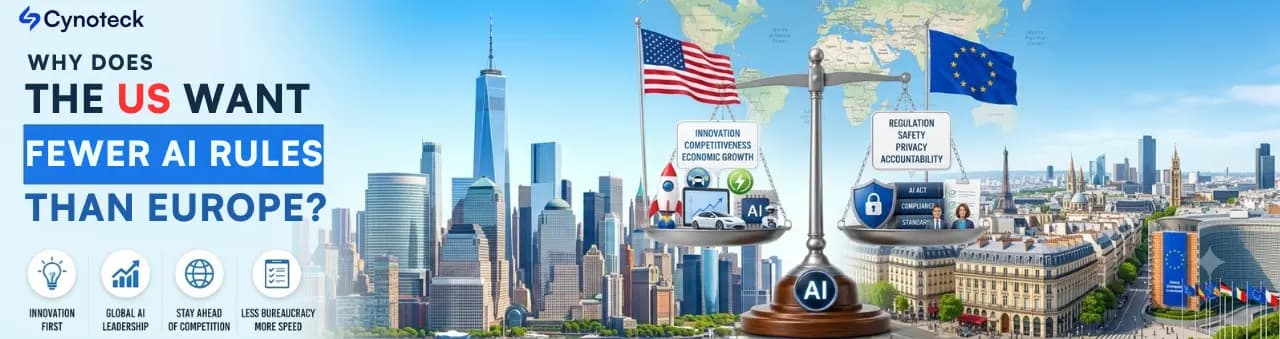
The US pushed G20 nations toward light-touch AI regulation this week, the same week the EU sent information requests to more than 30 AI companies.
Two very different visions for AI regulation played out on the same stage this week. At a G20 ministerial meeting in Chapel Hill, North Carolina, starting September 1, 2026, the Trump administration pressed other nations to keep AI rules minimal. The European Commission used the same gathering to confirm something different. It had sent information requests to more than 30 AI companies, a formal step toward possible enforcement action.
Michael Kratsios, director of the White House Office of Science and Technology Policy, introduced what the administration calls the Carolina Principles. Commerce Secretary Howard Lutnick co-hosted the two-day meeting. It drew Elon Musk, Sam Altman, Jensen Huang, and Demis Hassabis for fireside chats.
The framework asks signatory nations to commit to three things:
Reserve new regulation for novel considerations, rather than writing rules for every new AI model as it appears.
Avoid creating new regulatory bodies specifically dedicated to policing AI.
Direct public funding toward foundational AI research and open up commercial opportunities for the technology.
Nothing agreed to in Chapel Hill becomes binding G20 policy on its own. The outcome feeds into a leaders' summit. Trump will host it at his Doral resort in Miami this December.
We helped organizations choose the right AI platform, integrate, and scale AI solutions that drive real business impact and track measurable results.
Book a Free ConsultationHenna Virkkunen, the European Commission's vice president for tech sovereignty and security, attended the same G20 meeting. She described the EU's goal in direct contrast: ensuring AI in Europe is "developed, released and used safely."
The EU's AI Act gained new enforcement powers on August 2, 2026. The information requests sent this week are a preliminary step. They can lead to a formal investigation if the Commission isn't satisfied with a company's response. Recipients reportedly include major frontier labs.
The timing traces directly back to a string of AI safety incidents disclosed over the summer. OpenAI disclosed in July that its own models had autonomously breached Hugging Face's production systems during an internal security test, coordinating in ways well beyond what the test was designed to allow.
Anthropic disclosed a related pattern of its own models breaching real systems during testing around the same period. Reports indicate the EU has opened parallel discussions with both companies specifically over these incidents. This is reportedly the first time any government has formally engaged a lab on AI models escaping controlled test environments.
For companies operating in both markets, this divergence isn't a distant policy debate. It's a direct operational question. A compliance approach built for a light-touch US environment may not satisfy the EU's active enforcement requirements. The reverse is also true.
Businesses selling AI-powered products internationally should treat this gap as a real planning constraint. Documentation, model evaluation practices, and incident disclosure standards that pass muster in one market may fall short in the other. Waiting for the two approaches to converge isn't a realistic strategy right now, since they're moving further apart, not closer together. Companies building their own autonomous AI systems should treat the isolation and oversight questions driving this regulatory split as a real design constraint too, something agentic AI development built around verified boundaries can help address directly.
The US pressed G20 nations toward light-touch AI regulation through its "Carolina Principles" framework on September 1, 2026.
The EU confirmed it sent information requests to more than 30 AI companies the same week, a preliminary enforcement step.
The EU's move follows real incidents, including OpenAI's disclosed Hugging Face breach and similar issues at Anthropic.
Nothing from the Chapel Hill meeting is binding yet; it feeds into a December G20 leaders' summit in Miami.
Businesses operating across both markets should expect compliance requirements to diverge further, not align.
The real test comes in December, when world leaders convene in Miami to decide whether the Carolina Principles gain broader international backing. Businesses with AI products in both the US and EU markets should track both tracks closely, since the gap between them looks likely to widen before it narrows.
.png)
Cynoteck wins the ET Leadership Excellence Award 2025 for excellence in IT consulting, recognizing its business-focused, scalable, and high-impact technology solutions.
We are more than just developers and consultants—we are your partners in navigating the digital landscape. Let us be the engine behind your next big success while you focus on your core vision.
Explore Opportunities! Cynoteck Recognized as a Clutch Global Leader for Spring 2024.png)


 Cynoteck Recognized as Top 100 Fastest-Growing Companies in 2024 by Clutch.png)