Bill Gates Says Up to 40% of Jobs Could Be 'Human Reserved'
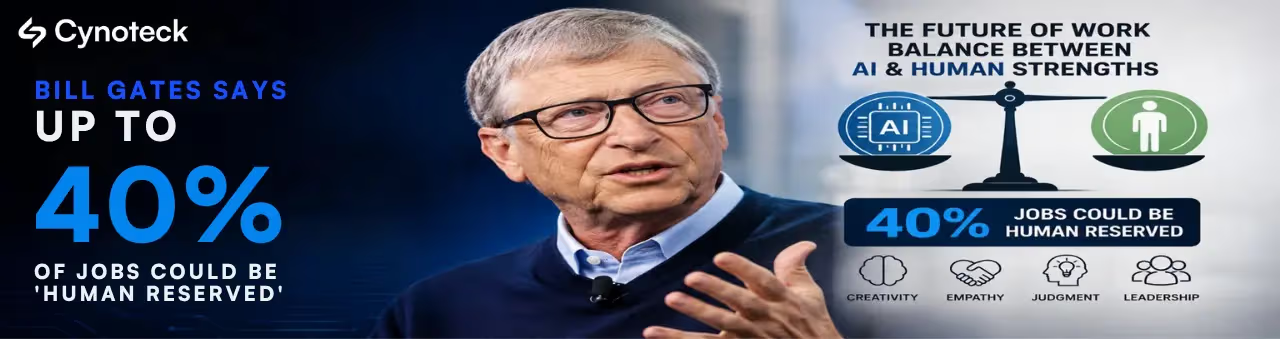
Bill Gates published a nearly 6,000-word essay warning AI could destroy jobs, harm kids, and empower criminals, urging some work stay human-only.
Bill Gates published a nearly 6,000-word essay on August 26, 2026. In it, the Microsoft co-founder lays out three risks he believes world leaders are unprepared for. Work is disappearing, especially for young people. Criminals are gaining capabilities they never had before. AI companions are putting children's development at risk by replacing real relationships.
This marks a real shift for Gates. He spent years arguing AI would make the world better. Now he says, plainly, that he's worried.
Gates's central proposal is a concept he calls Human Reserved work. The idea borrows from nature reserves. Society could develop certain land, but chooses not to, because the loss would be too great. Gates wants to treat some jobs the same way.
He names two categories:
Permanent protection: Roles like childcare and jury service, jobs Gates says humans are simply better suited for.
Temporary protection: Support for workers who can't realistically retrain, like manufacturing workers late in their careers.
Gates has tried to calculate how much employment this could realistically cover. In an extreme version, he thinks up to 40 percent of jobs could be reserved for humans. Getting there proved harder than he expected. That's the ceiling he could find, not a comfortable estimate.
We helped organizations choose the right AI platform, integrate, and scale AI solutions that drive real business impact and track measurable results.
Book a Free ConsultationJobs policy is only half of Gates's proposal. He also wants governments to tax AI compute tokens and robots directly, not just corporate profits.
His reasoning is straightforward. A company hiring a human worker pays payroll taxes. A company buying a robot instead gets to depreciate the cost, with no equivalent tax at all. Gates argues that imbalance actively pushes companies toward automation, even when a human would do the job just as well.
He first floated a robot tax back in 2017. Economists were skeptical then, arguing it would tax productivity rather than protect workers. What's changed isn't the argument. It's how many more people now think something like it may be necessary.
Gates doesn't hedge much here. He says he'd stake his reputation on AI proving bad for employment. In his own words: "I'd love to be convinced that I'm wrong about the job market, but I'm not."
That kind of certainty from someone who spent decades building and profiting from technology carries real weight. Gates isn't an outside skeptic. He's an insider who changed his mind after watching the industry blow past its own warning signs on bioweapon risk, cyberattacks, emotional dependency, and job losses.
Gates's warning lands as businesses decide how deep AI should reach into their operations. That tension shows up across the industry right now. Anthropic's own struggle to retain researchers shows that even the companies building this technology are wrestling with what actually motivates people to stay in a job, mission, or money.
Businesses shouldn't treat Gates's essay as a policy paper to wait on. It's a signal that workforce planning around AI adoption needs a real strategy now, not a reactive one once jobs start disappearing. Deciding which roles benefit from AI augmentation, versus which ones a business wants to keep human on purpose, is worth deciding before circumstances force it. That planning should start with AI services and solutions built around real workforce impact, not just technical capability.
Bill Gates published a nearly 6,000-word essay on August 26, 2026, reversing his previous optimism about AI's impact on jobs.
He proposes "Human Reserved" jobs, protecting roles like childcare and jury service from full automation.
Gates estimates that, at the extreme end, up to 40 percent of jobs could realistically be reserved for humans.
He also wants AI compute tokens and robots taxed directly, since current tax policy favors automation over hiring.
Gates says he would stake his reputation on AI ultimately harming the job market.
Gates says a related essay on AI and biosecurity is coming before the end of the year. Businesses watching this debate should treat his jobs proposal as an early signal, not a settled framework. The practical questions of who qualifies and who decides remain wide open.
.png)
Cynoteck wins the ET Leadership Excellence Award 2025 for excellence in IT consulting, recognizing its business-focused, scalable, and high-impact technology solutions.
We are more than just developers and consultants—we are your partners in navigating the digital landscape. Let us be the engine behind your next big success while you focus on your core vision.
Explore Opportunities! Cynoteck Recognized as a Clutch Global Leader for Spring 2024.png)


 Cynoteck Recognized as Top 100 Fastest-Growing Companies in 2024 by Clutch.png)