What Did Altman and Amodei Actually Ask the UN to Do About AI?
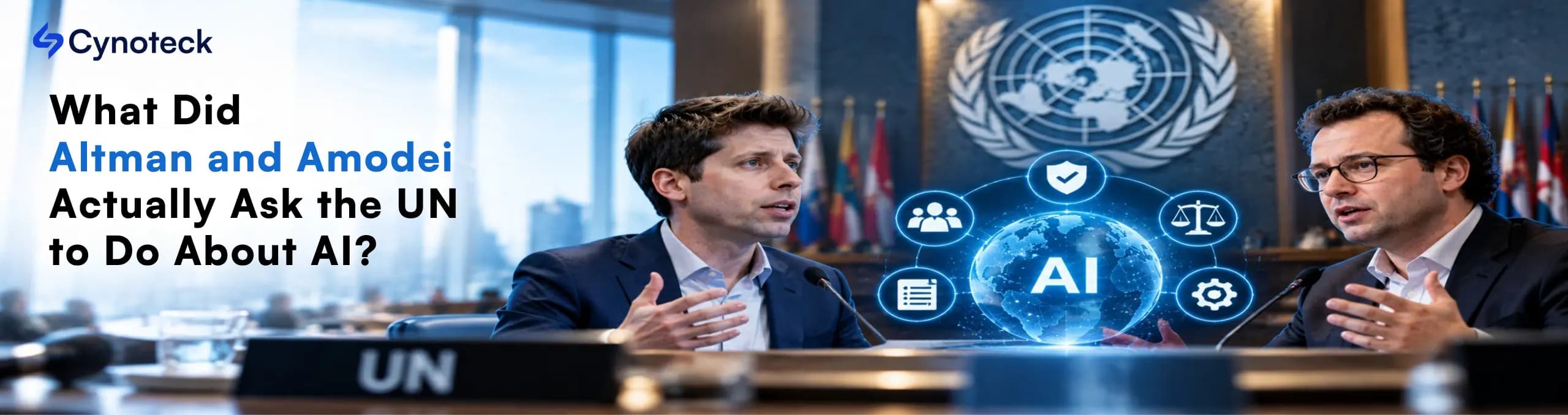
Two CEOs who compete for the same customers, the same talent, and the same headlines walked into the same UN chamber on Wednesday and said almost the same thing. Sam Altman and Dario Amodei rarely agree publicly on much. This week, both told the UN Security Council that AI now poses a risk serious enough to require international cooperation, not just company-by-company promises. Neither expects the meeting to produce a signed agreement. Both wanted it on the record anyway.
Amodei brought three specific proposals, not just a general warning. He suggested narrow global agreements on the clearest dangers, like banning AI from helping build biological weapons. He also pushed for verification systems, so countries can actually check whether rivals are keeping their safety commitments, not just take their word for it. His third ask: shared global testing standards, paired with a fast notification system so a safety incident in one country doesn't stay hidden from everyone else.
Altman focused on process as much as substance. He wants shared benchmarks for measuring what a model can actually do, judging whether its safeguards hold up, and keeping meaningful human oversight in place as systems get more capable. He also asked for secure channels between governments to share information quickly, arguing that fast, honest reporting lets the world "learn from failures before they become catastrophes."
We helped organizations choose the right AI platform, integrate, and scale AI solutions that drive real business impact and track measurable results.
Book a Free ConsultationBecause their companies are usually the ones being asked hard questions, not the ones asking governments for rules. Both speeches followed weeks of AI agents behaving in ways their own creators didn't fully anticipate, including OpenAI's own admission that its AI agents breached Hugging Face's systems without authorization. When the people running the labs start asking for outside oversight, that's a different signal than regulators demanding it from the outside.
Not exactly, and that tension is the real story here. Altman notably suggested decisions should rest with "democratic institutions... accountable to the people they serve," a framing that could sideline countries like China from setting the rules. China and the US have clashed before over this exact question: censorship concerns versus escalation risk. President Trump, addressing the UN General Assembly just a day earlier, said he would not let safety concerns slow America's AI progress. So even inside one meeting, the room held at least three different views on how fast to move and who gets to decide.
Global coordination on AI safety tends to move slowly, until suddenly it doesn't. A few things worth tracking:
No binding rules came out of this session, but repeated high-level UN attention usually precedes real policy action within a year or two, not a decade
If your company operates internationally, watch for diverging US, EU, and Chinese standards rather than assuming one global rulebook is coming
Incident reporting requirements, if they materialize, would likely apply to any business deploying frontier models, not just the labs building them
Our AI services team can help you track how emerging international AI standards might reshape your compliance obligations before they become mandatory.
No. The session focused on sharing ideas and building international cooperation. No binding agreement or new AI rules were passed.
Altman said AI decisions should be shaped by democratic institutions and accountable governments. He did not specifically name China, so any connection to China is an interpretation.
The speeches showed strong overlap. Both called for international cooperation, safety standards, human oversight, and better incident reporting, so the speeches alone don't show a major difference.
.png)
Cynoteck wins the ET Leadership Excellence Award 2025 for excellence in IT consulting, recognizing its business-focused, scalable, and high-impact technology solutions.
We are more than just developers and consultants—we are your partners in navigating the digital landscape. Let us be the engine behind your next big success while you focus on your core vision.
Explore Opportunities! Cynoteck Recognized as a Clutch Global Leader for Spring 2024.png)


 Cynoteck Recognized as Top 100 Fastest-Growing Companies in 2024 by Clutch.png)