10 Practical Strategies to Improve Your Sales Performance for Businesses

Almost every business owner wants the same thing: more sales, faster, without spending a fortune to get there. The tricky part is figuring out what actually moves the needle and what just keeps your team busy.
Boosting sales performance isn’t always about finding more leads. Sometimes, the biggest opportunities are already sitting in your pipeline. You just need a better process, stronger follow-ups, clearer customer communication, and smarter decisions based on what’s actually working.
In this article, we’ll look at 10 practical strategies to improve sales performance, help your team work more effectively, and turn more opportunities into real revenue.
Vague targets like "sell more this quarter" don't give reps much to work toward. Set goals that are Specific, Measurable, Achievable, Relevant, and Time-bound. For example, "close 12 qualified deals in the mid-market segment by the end of Q2" is much clearer than simply saying "increase sales."
Track win rate, average deal size, sales cycle length, and quota attainment alongside your goals, rather than checking them only after the results are in.
Review targets every month, not just once a year, so you can spot problems early and make adjustments while there’s still time to improve.
Make goals visible to the whole team. People are more likely to stay engaged when they can see their progress and understand how their work contributes to the bigger picture.
Break annual targets into quarterly and monthly milestones. This makes it easier to spot a slow start and take action before it turns into a lost year. A rep who is 20% behind in January is much easier to help than one who is 20% behind in November.
Keep activity goals, such as calls made and demos booked, separate from outcome goals, such as revenue closed. Both are important, but keeping them separate helps you understand whether the problem is a lack of effort or a problem with conversion.
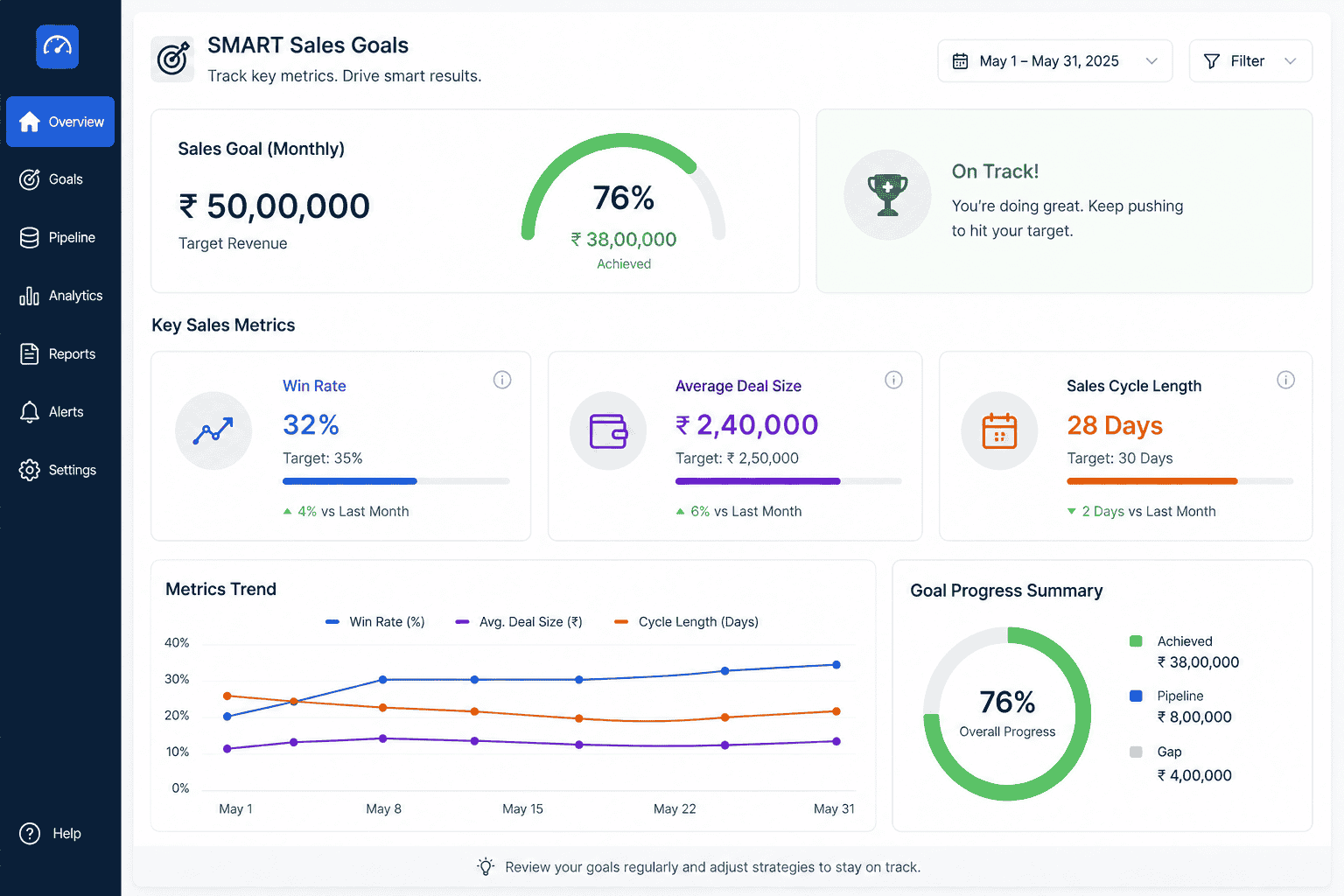
Goal setting only works when you keep an eye on progress. A goal nobody checks until the quarter ends isn’t really a management tool. It’s more of a wish. Set up a simple weekly or biweekly check in where reps and managers review the numbers together, spot what’s working, and address problems early instead of waiting for the end of the quarter.
Reps who jump straight into product features without understanding what the buyer actually needs can easily lose deals to competitors who take the time to listen. A buyer-centric approach means helping your sales team understand the prospect’s situation before suggesting a solution.
Teach reps to ask discovery questions that uncover the business impact of a problem, not just the budget and timeline.
Build talk tracks around common customer pain points instead of simply walking through a list of features.
Review call recordings or notes regularly to see whether reps are really listening or just waiting for their turn to pitch.
Encourage reps to ask what happens if the buyer does nothing. The cost of inaction can sometimes be more powerful than another feature comparison.
Identify the two or three pain points that come up most often in successful deals and use them to improve your messaging for the next quarter instead of relying on outdated buyer personas.
This matters even more today because buyers often do their own research before speaking with a salesperson. When they finally agree to a call or meeting, they are looking for someone who can genuinely help them, not someone who simply wants to sell them something.
One-time onboarding is not enough when customer expectations and buying behavior keep changing. Strong sales teams treat coaching as an ongoing process rather than something that happens only when a new rep joins.
Run short, regular skills workshops based on specific gaps you can see in your sales data, such as a rep whose discovery calls rarely turn into proposals.
Use role-play to practice handling objections before important calls, rather than limiting it to the onboarding process.
Make feedback a regular part of the job. Gallup research found that employees are 3.6 times more likely to feel motivated to do outstanding work when they receive feedback daily or weekly rather than annually.
What is one of the most valuable technology investments for improving sales performance? For many teams, it is a properly configured CRM. When your CRM is set up around your actual sales process and your team uses it consistently, you get cleaner pipeline data, better activity tracking, and more reliable forecasts.
A CRM should reduce repetitive work such as data entry and chasing updates, not create another task for reps to remember.
According to Zippia research, 91% of companies with 10 or more employees already use a CRM system, and 45% report that CRM adoption directly increased sales revenue. For most businesses, the question is no longer whether to use a CRM, but whether the current system is actually helping the sales team.
Automate tasks such as quote generation, follow-up reminders, and lead routing so reps can spend more time talking to potential customers.
We cover exactly how to choose the right CRM for your sales process later in this article.
Old case studies, lengthy presentations, and outdated pricing sheets can slow down your sales team and make your business look less credible. Good sales content should help reps move deals forward, not make them spend time searching for the right document.
Review your content library every quarter and remove anything with outdated pricing, discontinued features, or old branding.
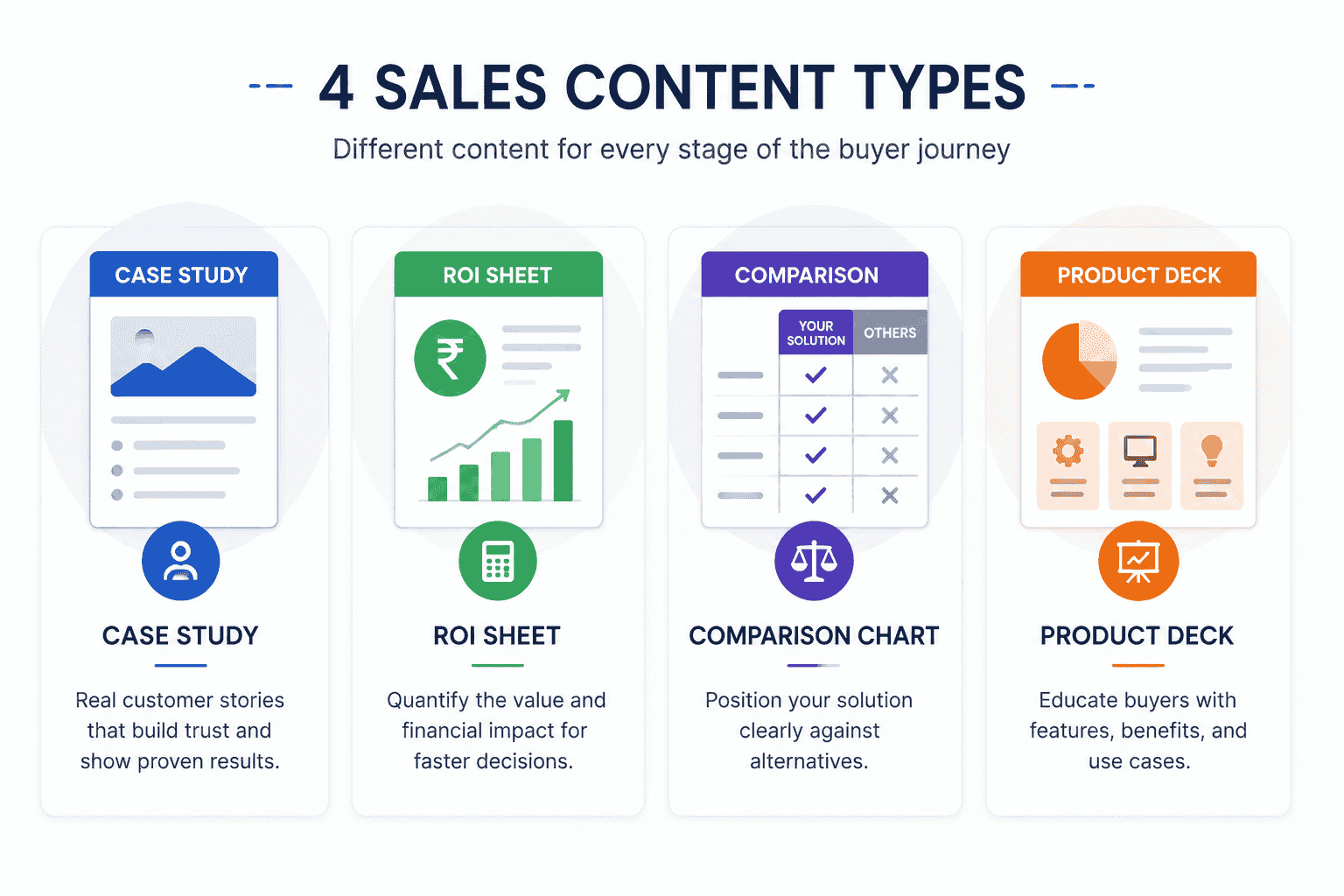
Create a small collection of useful assets, such as a strong case study, a simple ROI calculator, and a one-page comparison sheet, instead of building a huge library that nobody uses.
Organize content by buyer stage so reps can quickly find the right resource when they need it.
If you want your sales team to focus on renewals and growing existing accounts, but your commission plan only rewards new customers, you may end up encouraging the wrong behavior. CaptivateIQ's 2024 State of Incentive Compensation Management report found that only 17% of commission leaders reward reps for account renewals, while just 25% do so for upsells.
Connect your commission structure to the results that matter most to the business, whether that means new customers, upsells, retention, or a combination of these.
Keep the plan simple enough for reps to understand and calculate their potential commission without needing a spreadsheet.
Review your incentive plan at least once a year and adjust it as your business priorities change.
Your existing customers already know and trust your business, which can make them much easier to sell to than completely new prospects. The key is knowing what to offer and when to offer it.
Use CRM purchase history to identify natural upsell opportunities, such as upcoming renewals, increased usage, or important contract milestones.
Train reps to position an upsell as a way to solve a bigger customer problem rather than simply adding another product or service.
Set a specific revenue target for existing customer expansion so it gets the same attention as new business.
Not every sales or marketing channel will deliver the same results. Instead of spreading your resources everywhere, focus on the channels where your ideal customers are actually spending time.
Review conversion data by channel every quarter and reduce investment in channels that consistently produce poor results.
Use targeted and personalized email follow-ups instead of sending generic messages to everyone. Relevant messages are more likely to get attention.
Make sure sales and marketing agree on what qualifies as a good lead. Clear lead definitions and scoring can prevent wasted time and poor handoffs.
Closing the deal is only the beginning. Happy customers are more likely to stay, buy again, and recommend your business to others. That can reduce the pressure on your sales team to constantly find new customers.
Set regular post-sale check-ins so potential problems are identified well before renewal time.
Make it easy for satisfied customers to refer your business. A simple and well-timed request can work better than a complicated referral program that customers rarely notice.
Track customer health and engagement in your CRM alongside your sales metrics so potential retention issues are visible to sales leadership.
Pricing is often overlooked when businesses look for ways to improve sales performance. But the price that worked a few years ago may no longer reflect your value, customer expectations, or changes in the market.
Review competitor pricing at least twice a year, particularly if you operate in a fast-changing market.
Test different packages, pricing tiers, or limited-time offers to understand how customers actually respond to pricing instead of relying on assumptions.
Make sure any pricing changes are updated everywhere, including your website, sales presentations, CRM, and quote templates. Quoting an old price can quickly damage customer trust.
Buyers are doing more research on their own before they ever speak with a sales rep. Many are also using AI tools to compare vendors, understand products, and narrow down their options. HubSpot's 2025 sales research found that 74% of sellers say AI has made it easier for buyers to gather information independently.
This shift means sales teams need to be sharper, faster, and better prepared when a real conversation finally happens. For businesses looking to improve sales performance, simply generating more leads is no longer enough. Teams also need better sales processes, stronger customer conversations, and the right technology to turn opportunities into revenue.
The good news is that there are practical ways to boost sales without relying on a single motivational push at the beginning of every quarter. The most effective approach is to improve the areas that directly influence sales results, including goals, people, processes, technology, customer experience, and pricing.
If you're wondering how to improve sales performance, start by measuring the right numbers. You'll know your sales strategy is working when your win rate, average deal size, and sales cycle length improve consistently over several quarters, not just during one good month.
A strong month can simply come from deals that happened to close at the right time. To understand whether you're actually improving sales performance, track these four metrics every month:
Win rate: The percentage of opportunities that turn into won deals
Average deal size: Whether your upselling, cross-selling, and pricing efforts are increasing the value of each deal
Sales cycle length: Whether better discovery, content, and processes are helping deals close faster
Quota attainment rate: The percentage of reps consistently hitting their targets, which shows whether sales success is spread across the team or dependent on a few top performers
If only a small group of reps consistently hit quota while the rest of the team struggles, the issue may not be the market. It could point to gaps in coaching, sales processes, lead quality, or execution. Identifying these gaps is an important part of learning how to improve sales performance and build a more consistent sales engine.
Even teams that are actively trying to improve sales performance can fall into a few common traps. These mistakes may seem small at first, but over time, they can slow growth, reduce conversion rates, and make it harder to boost sales consistently.
Chasing more leads instead of better qualified ones: More leads do not always mean more sales. If the leads are not a good fit, your sales team simply spends more time working opportunities that are unlikely to close.
Letting CRM data become outdated: Sales forecasts are only as reliable as the data behind them. Outdated pipeline information can lead to poor decisions about hiring, budgets, and sales targets.
Treating coaching as a one time activity: Sales coaching should continue after onboarding. Regular feedback and practice help reps improve their skills as customer expectations and buying behavior change.
Using incentive plans based on old priorities: If your commission structure rewards the wrong behaviors, it can work against your current sales goals. Make sure incentives support what you actually want your team to achieve.
Focusing only on new customers: Existing customers can be an important source of upsell, cross sell, and repeat revenue. Ignoring them can mean leaving valuable sales opportunities on the table.
Using different definitions of a qualified lead: Sales and marketing need to agree on what makes a lead sales ready. Otherwise, reps may spend valuable time following up with prospects who are not ready to buy.
Measuring activity instead of results: Making 50 calls a day may look impressive, but activity alone does not guarantee better sales performance. Look at whether those calls are reaching the right buyers and creating real opportunities.
None of these problems needs a massive solution on its own. The real problem starts when several of them exist at the same time. Poor CRM data, weak coaching, unclear goals, and misaligned incentives can slowly add up and make it much harder for a sales team to hit its targets.
Many of the strategies discussed in this guide depend on having the right CRM system in place. A CRM should support the way your sales team actually works, rather than forcing reps to work around a generic setup.
Cynoteck Technology Solutions helps businesses implement and customize Microsoft Dynamics 365 Sales and Salesforce Sales Cloud to support better pipeline management, forecasting, automation, reporting, and sales execution.
Our CRM services can include:
CRM implementation and configuration: Set up sales stages, territories, workflows, approvals, and other processes around your business.
CRM customization: Build pipeline views, deal scoring, forecasting, dashboards, and reports that give sales leaders better visibility.
CRM integration: Connect your CRM with marketing, finance, customer support, and other business systems to reduce data silos.
Data migration: Move customer and pipeline data from spreadsheets or legacy CRM platforms while preserving important historical information.
Training and ongoing support: Help your sales team adopt the CRM properly and continue getting value from it after implementation.
CRM implementation costs vary depending on the number of users, required modules, customization, integrations, data migration, and support requirements. There is no single price that fits every business.
If you are looking for ways to improve sales performance with CRM, working with an experienced CRM consulting partner can help you identify where your current system is creating bottlenecks and what needs to change.
Talk to a Dynamics 365 consultant to discuss your sales process and identify the right CRM approach for your business.
Start by looking at the parts of your sales process that have the biggest impact on conversion. Better lead qualification, faster follow ups, stronger discovery calls, and clean CRM data can often deliver improvements without adding more sales reps.
Focus on getting more value from your existing pipeline. Improve lead qualification, follow up faster, strengthen discovery calls, and look for cross-sell and upsell opportunities with existing customers. CRM automation can also reduce administrative work and give reps more time to focus on selling.
There is no single CRM that is best for every business. Microsoft Dynamics 365 Sales is strong options for businesses that need advanced customization, automation, integrations, and reporting. HubSpot, Zoho, and Pipedrive may be better suited to smaller teams looking for simpler implementation. The right CRM depends on your sales process, team size, budget, and existing technology.
Sales goals should be reviewed at least monthly, with a more detailed review each quarter. Regular reviews help managers identify problems early and make adjustments before a missed target becomes a larger performance issue.
A CRM can contribute to higher revenue by improving lead follow up, pipeline visibility, customer information, and sales productivity. However, simply purchasing a CRM does not guarantee better results. Proper configuration, user adoption, training, and ongoing management are critical to getting value from the system.
One of the biggest problems is inconsistent execution. A business may have good sales goals, training, technology, and incentives, but if managers do not regularly track progress and address problems, those strategies lose their impact. Improving sales performance requires ongoing attention rather than a one time initiative.
Review incentive plans at least once a year and whenever your business priorities change. If your focus shifts from acquiring new customers to customer retention, upselling, or expansion revenue, your compensation plan should encourage those behaviors.
Improving sales performance is rarely about one big change. It usually comes from making several important parts of your sales operation work better together.
Clear goals help your team understand what success looks like. Regular coaching helps reps improve. Better CRM data gives managers the visibility they need to make smarter decisions. The right incentives encourage the behaviors that matter, while better pricing and customer strategies create more opportunities to boost sales.
If you want to know how to improve sales performance, start by identifying the biggest gap in your current sales process. It could be poor lead qualification, inconsistent follow ups, outdated CRM data, weak coaching, or missed opportunities with existing customers.
The sales teams that perform well in 2026 are not necessarily the ones working the hardest. They are often the ones with better data, clearer processes, and systems that help them identify and fix problems before those problems turn into missed targets.
Find out where your sales process is losing opportunities and how the right CRM, automation, and sales strategy can help your team convert more leads into revenue.
Talk to a Sales & CRM Expert
Discover the top 10 benefits of custom CRM software development for modern businesses. Learn how tailored CRM solutions improve efficiency, enhance customer relationships, and drive business growth.
We are more than just developers and consultants—we are your partners in navigating the digital landscape. Let us be the engine behind your next big success while you focus on your core vision.
Explore Opportunities! Dynamics 365 Sales Pricing, Features & Alternatives.webp)
.png)
 Power BI vs Excel (1).webp)
 Top 10 Cloud Based CRM Platforms Compared (Features, Pricing & Pros).webp)